Support our hydrofoil educational content for free when you purchase through links on our site. Learn more
🚀 10 Pro Tips for Improving Balance on a Hydrofoil Board (2026)

The single most effective tip for improving balance on a hydrofoil board is to shift your weight significantly further back than you think you need to, leaning into your heels to prevent the nose from diving. Most riders spend their first year fighting a “nose-heavy” instinct that kills their lift, but mastering this rear-weighted trim instantly transforms a wobbly struggle into a smooth, silent glide.
If you’ve ever felt like you’re riding a unicycle on a tightrope while the ocean laughs at you, you aren’t alone. We’ve all been there: the board lifts, the nose dips, and splash—you’re tasting saltwater again.
The secret isn’t stronger legs or a better board; it’s understanding that a foil is an airplane, not a surfboard.
Here are our 10 essential tips for improving balance on a hydrofoil board that will help you stop fighting the water and start flying above it.
Key Takeaways
- Rear-Weighted Trim is King: You are likely riding too far forward; moving your back foot further back stabilizes the foil and prevents nose-dives.
- Helside Lean: Maintain a slight lean onto your heels to keep pressure on the foil’s leading edge for consistent lift.
- Soft Legs, Not Rigid Pillars: Keep your knees bent and relaxed to act as natural shock absorbers against chop and turbulence.
- Dry Land Training Works: Spending just 15 minutes a day on a balance board can rewire your neuromuscular response for on-water stability.
- Gear Matters: Ensure your foil setup (mast length, wing size, and shims) matches your skill level to maximize forgiveness.
Table of Contents
- ⚡️ Quick Tips and Facts
- 📜 From Surfing to Sky: The Evolution of Hydrofoil Balance
- 🧠 Mastering Your Stance: The Foundation of Foil Stability
- 🦵 Leg Mechanics and Weight Distribution Secrets
- 🎯 10 Essential Drills to Crush Wobbles and Boost Confidence
- 🛠️ Gear Up: How Board and Foil Setup Impacts Your Center of Gravity
- 🌊 Reading the Water: Adapting Balance Techniques to Different Conditions
- 🚫 Common Mistakes That Kill Your Lift (And How to Fix Them)
- 🧘 Mental Game: Staying Calm When the Foil Starts Shaking
- 📊 Troubleshooting Guide: Diagnosing Your Balance Issues
- 🏆 Pro Insights: Lessons from the Hydrofoiling™ Team
- 🔗 Recommended Links
- ❓ FAQ: Your Burning Questions About Foil Balance Answered
- 📚 Reference Links
⚡️ Quick Tips and Facts
Before we dive into the nitty-gritty of why your board feels like a unicycle on a tightrope, let’s hit the high notes. If you’re reading this, you’ve probably already tasted the sweet freedom of gliding above the water, but maybe you’re also tasting a lot of saltwater from frequent faceplants. Here is the Hydrofoiling™ team’s rapid-fire cheat sheet to getting your balance sorted:
- The 95% Rule: You are likely riding too far forward. Yes, you read that right. Most foilers (including us, until we learned the hard way) lean forward, thinking it helps them catch the lift. In reality, it kills your pumping efficiency and makes the board unstable. Read more about optimal weight positioning.
- The “RC Plane” Analogy: Think of your board like a remote-controlled plane. If the nose is too heavy, it dives. If the tail is too heavy, it stalls. You need to find that sweet spot where the board flies without the stabilizer (stab) fighting you.
- Dry Land is Gold: You don’t need to be in the water to get better. Spending just 10–20 minutes a day on a balance board while watching TV can rewire your nervous system for foil stability.
- Footwork is King: It’s not just about your stance; it’s about continual foot adjustments. Your feet are your active suspension system.
- Helside is Your Friend: Leaning slightly towards your heelside (back foot pressure) is crucial for stability. Over-leaning toeside is a fast track to a belly flop.
📜 From Surfing to Sky: The Evolution of Hydrofoil Balance
The journey from a standard surfboard to a hydrofoil is a leap in physics, not just gear. Historically, foiling was the domain of windsurfers and kitefoilers who needed to reduce drag in light winds. But as the technology trickled down to stand-up foiling, the balance equation changed entirely.
In traditional surfing, your board floats on the surface. Your balance is a constant negotiation with the wave face. On a foil, you are flying. The board is no longer your primary point of contact with the water; the hydrofoil wing is. This shifts your center of gravity (CG) and demands a completely different neuromuscular response.
“The mast is primarily relevant during pumping; for static balance, focus on the relationship between the rider’s Center of Gravity (CG) and the foil’s lift point.” — Progression Project Forum
Early foilers struggled because they applied surf logic to a flying machine. They stood too far forward, trying to “ster” with their front foot, which caused the nose to dive or the tail to lift uncontrollably. The evolution of balance on a hydrofoil board has been a story of unlearning bad habits. We’ve moved from the “nose-heavy” era to the modern understanding of rear-weighted trim.
If you want to understand the mechanics behind this shift, check out our deep dive on What is hydrofoiling and how does it work?.
🧠 Mastering Your Stance: The Foundation of Foil Stability
Your stance is the chassis of your flying machine. If the chassis is croked, the car won’t drive straight, no matter how good the engine is. On a hydrofoil, your stance isn’t static; it’s a dynamic, living thing.
The “Neutral” Myth
Many beginners are told to find a “neutral” stance. On a foil, neutral is a myth. You are always actively managing pressure.
- Front Foot: Acts as your rudder and primary steering input. It should be placed just behind the mast track.
- Back Foot: This is your throttle and stabilizer. It controls the pitch (nose up/down) and the roll (lean).
The Helside Lean
One of the most counter-intuitive concepts for new foilers is the heelside lean.
- Why? When you lean heelside, you engage the edge of the board, which transfers pressure to the foil’s leading edge, creating lift and stability.
- The Trap: Leaning toeside (toes down) removes pressure from the foil, causing it to lose lift and crash.
- The Fix: Keep your weight slightly back and lean into your heels. As the first video in our series explains, “To keep your balance, you do need to lean slightly towards heel side.”
Visualizing the Stance
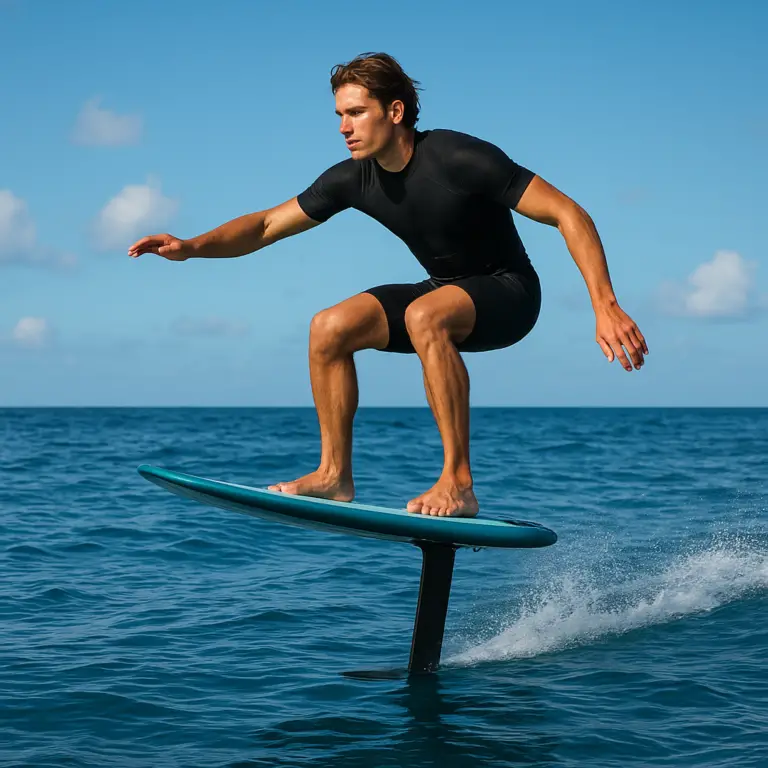
Imagine you are standing on a skateboard on a slope. If you lean forward, you roll. If you lean back, you stop. On a foil, leaning back (heelside) keeps you flying. Leaning forward (toeside) makes you dive.
Pro Tip: If you feel like you’re constantly falling forward, you are likely too far forward on the board. Move your back foot further back!
🦵 Leg Mechanics and Weight Distribution Secrets
Your legs are not just pillars holding you up; they are shock absorbers and active control surfaces. The difference between a smooth glide and a violent wobble often comes down to how you distribute weight between your knees and ankles.
The “Soft Knee” Technique
Rigid legs are the enemy of balance. When your legs are locked, every ripple in the water sends a shockwave through your body, destabilizing your foil.
- Bend Your Knees: Keep a constant, slight bend in your knees. This allows your legs to absorb the micro-bumps in the water.
- Ankle Articulation: Your ankles should be doing the heavy lifting for fine-tuning. Small adjustments in ankle pressure can correct a wobble before it becomes a fall.
Weight Distribution: The 60/40 Rule
While the exact ratio changes with speed and conditions, a good starting point for stability is 60% weight on the back foot and 40% on the front.
- Too much front weight: The nose dives, the foil stalls, and you crash.
- Too much back weight: The board lifts too high, the foil loses speed, and you “porpoise” (bounce up and down).
The “Pump” Connection
Proper weight distribution is critical for pumping. If you are too far forward, you can’t generate the leverage needed to pump the board up and down to gain speed. As noted by the community, “I think probably 95% of foilers including myself regularly are way forward of where they should be for pumping.”
🎯 10 Essential Drills to Crush Wobbles and Boost Confidence
You can read all theory you want, but balance is a muscle memory skill. Here are 10 essential drills to take you from wobbly novice to smooth operator. These range from dry-land exercises to on-water techniques.
- The Balance Board Daily Grind: Use a Revolution Swell or Vew-Do balance board for 15 minutes a day. Set it to the “super tippy” mode (perpendicular roller) to simulate the instability of a foil.
- The “One-Leged” Stand: Stand one leg while brushing your teeth. Close your eyes. This forces your proprioception (body awareness) to fire up.
- The SUP Trainer Combo: Combine a balance board with a Vasa Swim Trainer. Lay prone on the trainer while balancing on the board. This simulates the core engagement needed for foiling without the water.
- The “Back Foot Only” Drill: On the water, try to steer and balance using only your back foot for a few minutes. This isolates the pressure control mechanism.
- The “Slow Glide” Challenge: Try to fly as slowly as possible without stalling. This forces you to find the exact center of your balance point.
- The “Wobble Stop” Drill: When you feel a wobble, do not fight it with your arms. Instead, bend your knees and shift your weight slightly back.
- The “Helside Hold”: Practice leaning heavily on your heels while standing still on the board (in shallow water or on land). Get comfortable with that feeling.
- The “Pump and Glide” Rhythm: Focus on a smooth, rhythmic pump. Up, down, up, down. Don’t rush. The rhythm is the key to stability.
- The “Turn and Recover”: Practice making small, gentle turns and immediately recovering to a straight line. This teaches you to manage the shift in weight during maneuvers.
- The “Mental Reset”: When you fall, take a deep breath. Visualize the correct stance before you get back on. Panic is the biggest balance killer.
🛠️ Gear Up: How Board and Foil Setup Impacts Your Center of Gravity
Your gear is not just equipment; it’s an extension of your body. A poorly set up board can make even the most balanced rider look like a newborn giraffe.
Board Volume and Shape
- Volume: A board with too much volume (e.g., 10L+) can feel “floaty” and unstable at low speeds. A board with too little volume (e.g., 40L) requires perfect balance to stay on foil.
- Shape: Boards with a narrower tail are more responsive but less stable. Boards with a wider tail offer more stability but can feel sluggish.
Foil Size and Aspect Ratio
- High Aspect Foils: These are fast and efficient but require precise balance. They are less forgiving of errors.
- Low Aspect Foils: These are more stable and forgiving, making them ideal for beginners. They generate lift at lower speeds, giving you more time to adjust your balance.
Mast Length
- Short Mast (60-75cm): Closer to the water, more stable, less wind resistance. Great for learning.
- Long Mast (90cm+): Higher flight, more unstable, requires better balance.
The Shim Game
One of the most powerful tools for balancing your foil is the shim.
- Tail Shims: Adding shims to the tail of the board can help lift the nose if you are riding too far forward.
- Front Shims: Adding shims to the front can help if the nose is diving.
- The Goal: Remove shims once you have found your natural balance point. As one expert noted, “Removing tail shims (once the rider is positioned correctly) can make the board feel ‘very fast’ and ‘very easy to control’.”
👉 Shop Foil Components on:
- Amazon: Search for Hydrofoil Shims
- Brand Official: AXIS Foils | Glide Foils | Lib Tech
🌊 Reading the Water: Adapting Balance Techniques to Different Conditions
The ocean is never the same twice. Your balance strategy must adapt to the conditions.
Chopy Water
In chopy conditions, the board is constantly being thrown off balance.
- Strategy: Keep your knees very soft. Absorb the chop with your legs.
- Weight: Stay slightly more back to prevent the nose from diving into a wave.
- Speed: Maintain a steady speed. Too slow, and you’ll stall; too fast, and the chop will throw you off.
Flat Water
Flat water is the playground for perfecting your balance.
- Strategy: Focus on micro-adjustments. Use your ankles to fine-tune your trim.
- Weight: Find the exact center of gravity. This is where you can fly for hours.
- Speed: You can go slower in flat water, which gives you more time to react.
Windy Conditions
Wind adds a new variable: the force of the wind on your body and the board.
- Strategy: Lean into the wind. If the wind is pushing you forward, move your weight back.
- Weight: Distribute weight evenly to prevent the board from being blown sideways.
- Speed: You may need to go faster to maintain lift against the wind resistance.
🚫 Common Mistakes That Kill Your Lift (And How to Fix Them)
We’ve all been there. You’re flying, then bam, you’re in the drink. Here are the most common mistakes and how to fix them.
Mistake 1: Riding Too Far Forward
- The Symptom: The nose dives, you lose speed, and you crash.
- The Fix: Move your back foot further back. Imagine you are trying to lift the nose of the board with your back foot.
Mistake 2: Stiff Legs
- The Symptom: You feel every bump, and the board vibrates violently.
- The Fix: Bend your knees! Relax your legs. Let them act as shock absorbers.
Mistake 3: Leaning Toeside
- The Symptom: You lose pressure on the foil, and it stalls.
- The Fix: Lean into your heels. Keep your weight back.
Mistake 4: Over-Correcting
- The Symptom: You make a big movement to fix a small wobble, and you end up crashing.
- The Fix: Make small, subtle adjustments. Trust your foil.
Mistake 5: Looking Down
- The Symptom: You lose your horizon and get disoriented.
- The Fix: Look at the horizon. Your body will naturally follow your gaze.
🧘 Mental Game: Staying Calm When the Foil Starts Shaking
Balance is 50% physical and 50% mental. When the foil starts shaking, panic sets in, and you make big, jerky movements that make things worse.
The “Breathe and Trust” Technique
- Breathe: Take a deep breath. This calms your nervous system.
- Trust: Trust that your foil is designed to fly. Trust your training.
- Focus: Focus on your feet. Feel the pressure. Make small adjustments.
Visualization
Before you get on the water, visualize yourself flying smoothly. Imagine the feeling of the water rushing beneath you. This mental rehearsal can help your body react correctly when you are actually on the water.
Embracing the Fall
Falling is part of the process. Don’t get frustrated. Analyze what went wrong, adjust your stance, and try again. Every fall is a lesson.
📊 Troubleshooting Guide: Diagnosing Your Balance Issues
Not sure what’s wrong? Use this guide to diagnose your balance issues.
| Symptom | Likely Cause | Solution |
|---|---|---|
| Nose Diving | Too much weight on front foot | Move back foot further back |
| Tail Lifting | Too much weight on back foot | Move front foot forward |
| Violent Wobble | Stiff legs / Too fast | Bend knees / Slow down |
| Stalling | Leaning toeside / Too slow | Lean heelside / Pump for speed |
| Porpoising | Incorrect trim / Too much shim | Adjust shims / Find natural balance |
| Hard to Turn | Too much pressure on front foot | Shift weight to back foot |
🏆 Pro Insights: Lessons from the Hydrofoiling™ Team
We’ve spent thousands of hours on the water, and we’ve learned a thing or two. Here are our top insights from the team.
- Greenie’s Take: “I used to think I needed to be a gymnast to foil. Turns out, I just needed to stop leaning forward. Once I moved my weight back, everything clicked.”
- Radair’s Advice: “Don’t be afraid to experiment with your gear. A different foil size or a different board shape can make a world of difference.”
- KP_Foiler’s Secret: “Dry land training is a game changer. I spend 15 minutes a day on my balance board, and it’s made my on-water progress so much faster.”
- FoilGraham’s Insight: “The ‘RC Plane’ analogy changed my life. Once I started thinking about trim like a plane, I stopped fighting the board and started flying with it.”
- JF4246’s Tip: “Focus on your feet. Your feet are your connection to the foil. If you can feel the pressure, you can control the flight.”
- Seangalla’s Wisdom: “Patience is key. Don’t rush the process. Master the basics before moving on to advanced maneuvers.”
- JuanJohn’s Observation: “The water is always changing. Adapt your balance to the conditions. What works in flat water won’t work in chop.”
- Rycpt’s Experience: “I used to fall every time I tried to turn. Then I realized I was leaning too much. Small turns, small leans. It’s all about finese.”
👉 CHECK PRICE on:
- Balance Boards: Amazon | Walmart
- Hydrofoil Boards: Amazon | Brand Official
Conclusion

So, there you have it. The secret to mastering balance on a hydrofoil board isn’t magic; it’s a combination of proper weight distribution, soft legs, mental calm, and the right gear setup. Remember, you are likely riding too far forward. Move back, lean into your heels, and trust your foil.
The journey from wobbly to smooth is a process of trial and error, but with the right mindset and techniques, you’ll be gliding above the waves in no time. Don’t be afraid to fall; every fall is a step forward. Keep practicing, keep learning, and most importantly, have fun!
Ready to take your foiling to the next level? Check out our Advanced Hydrofoiling Techniques guide for more tips on pumping, turning, and riding waves.
Recommended Links
👉 Shop Hydrofoil Gear on:
- Hydrofoil Boards: Amazon | Walmart
- Foil Wings & Masts: Amazon | AXIS Foils | Glide Foils
- Balance Boards: Amazon | Revolution Swell | Vew-Do
Books & Resources:
FAQ: Your Burning Questions About Foil Balance Answered

How do I keep my balance when the hydrofoil board lifts?
Keeping your balance as the board lifts is all about weight distribution and anticipation. As the board begins to rise, you need to shift your weight slightly back to prevent the nose from diving. Keep your knees bent and your core engaged. Think of it as a dance: as the board lifts, you move back; as it stabilizes, you find your center.
What body position helps improve stability on a hydrofoil board?
The most stable body position is one where your weight is slightly back, your knees are bent, and you are leaning slightly into your heelside. Your arms should be relaxed, and your gaze fixed on the horizon. Avoid locking your legs or leaning too far forward.
Read more about “🚀 7 Best Hydrofoil Propulsion Systems Tested: Small Motors, Big Thrust (2026)”
Why does my hydrofoil board feel wobbly when I start riding?
Wobliness is often caused by stiff legs, incorrect weight distribution, or over-corection. If your legs are locked, you can’t absorb the micro-bumps in the water. If you are too far forward, the board will dive. If you over-correct, you’ll create a feedback loop of instability. Focus on softening your legs and finding your natural balance point.
Read more about “12 Common Hydrofoil Mistakes to Avoid in 2025 🚀”
What exercises can I do off the water to improve hydrofoil balance?
Dry-land training is incredibly effective. Use a balance board (like the Revolution Swell or Vew-Do) for 10-20 minutes a day. You can also practice standing one leg while brushing your teeth or using a SUP trainer with a balance board to simulate the core engagement needed for foiling.
Read more about “🚀 7 Core Strength Exercises for Hydrofoil Foiling (2026)”
Reference Links
- Progression Project Forum: Foil Trim – how to get the balance right – Technique
- Progression Project Forum: Does balance board training help?
- AXIS Foils: Official Website
- Glide Foils: Official Website
- Hydrofoiling.org: What is hydrofoiling and how does it work?
- Hydrofoiling.org: Hydrofoil Basics
- Hydrofoiling.org: Hydrofoil Equipment Reviews
- Hydrofoiling.org: Advanced Hydrofoiling Techniques
- Hydrofoiling.org: Hydrofoil Board Selection
- Hydrofoiling.org: Hydrofoil Brands Comparison