Support our hydrofoil educational content for free when you purchase through links on our site. Learn more
10 Electric Hydrofoil Board Reviews: Find Your Ride ⚡

The best electric hydrofoil board for most new riders is a stable, forgiving setup from brands such as Flite, Lift, Waydoo, or SiFly—chosen for your weight, local water, and access to service, not just its top-speed claim. These hydrofoil electric hydrofoil boards reviews compare 10 models and explain what matters most: board size, foil choice, battery runtime, safety, and support.
The first eFoil session can humble even confident surfers: throttle on, board moving, balance suddenly negotiable. A well-matched beginner setup makes that learning curve a lot friendlier, while a compact performance board can feel like trying to balance on a flying dinner tray.
Key Takeaways
- Best all-around shortlist: Fliteboard and Lift offer broad setup options; compare the exact board, battery, foil, and local service support.
- Beginer-friendly picks: Consider the Flite Air, Waydoo Flyer EVO, SiFly Rider, or a stable Lift setup.
- Don’t buy by top speed alone: Rider weight, board volume, foil design, and water conditions shape the ride.
- Battery runtime varies: Speed, repeated takeoffs, rider weight, conditions, and battery age all affect time on the water.
- Safety and support matter: Check the cutoff system, protective gear guidance, warranty, replacement parts, and local riding rules.
👉 Shop eFoil brands: Fliteboard | Lift Foils | Waydoo | SiFly | Awake | Aerofoils
Table of Contents
- ⚡️ Quick Tips and Facts: Electric Hydrofoil Boards at a Glance
- 🌊 Electric Hydrofoil Board Background: How eFoiling Took Off
- 🏄 What Is an Electric Hydrofoil Board?
- ⚙️ How eFoil Boards Work: Motor, Mast, Foil, and Battery
- 🔍 How We Review and Compare Electric Hydrofoil Boards
- Ride feel, stability, and beginner friendliness
- Battery range, charging, and real-world ride time
- Build quality, safety, service, and warranty
- 🏆 10 Electric Hydrofoil Boards Reviewed and Compared
- 1. Lift5 eFoil: Refined Performance and Customization
- 2. Fliteboard Series 5: A Versatile Premium eFoil
- 3. Flite Air Pro: An Inflatable, Travel-Friendly eFoil
- 4. Waydoo Flyer EVO Pro Plus: Feature-Rich and Modular
- 5. Awake VINGA 3: A Compact, Responsive Electric Foil
- 6. SiFly Rider: Smooth, Approachable Foilboarding
- 7. SiFly Stellar: Lightweight Design and Agile Handling
- 8. Audi e-tron foil by Aerofoils: Premium German Engineering
- 9. LiftX eFoil: A Compact Board for Travel and Progression
- 10. Takuma Cruising: A Stable Setup for Learning to eFoil
- 📊 Electric Hydrofoil Board Comparison: Specs and Ride Character
- Best eFoils for beginners, experienced riders, and travel
- Board volume, rider weight, and foil sizing explained
- 🛒 How to Choose the Best Electric Hydrofoil Board for You
- Matching an eFoil to your skill level and riding style
- Choosing board size, mast length, and wing setup
- Battery options, range claims, and replacement considerations
- New versus used eFoil boards: What to inspect
- 🔋 Battery Life, Charging, and Electric eFoil Running Costs
- 🧰 eFoil Setup, Transport, Storage, and Maintenance
- 🛟 Electric Hydrofoil Safety: Lessons for New Riders
- What happens if you fall off an eFoil?
- Protective gear, remote controls, and safe riding zones
- Learning to eFoil: First-ride tips and common mistakes
- 🌬️ Where and When to Ride an Electric Hydrofoil Board
- Wind, waves, water depth, and weather conditions
- Local rules, permits, and access considerations
- ⚖️ eFoil Boards vs. Surfboards, SUPs, and Other Foilboards
- 🌱 Electric Hydrofoils: Noise, Emissions, and Environmental Considerations
- ❓ Electric Hydrofoil Board Reviews: Frequently Asked Questions
- Are electric hydrofoil boards worth it?
- How fast do eFoil boards go, and how long can they ride?
- Are eFoils difficult for beginners to learn?
- Can you ride an eFoil without waves or wind?
- How much maintenance does an electric hydrofoil need?
- Can you travel with an eFoil battery?
- ✅ Final Verdict: Which Electric Hydrofoil Board Should You Choose?
- 🔗 Recommended Links
- 📚 Reference Links
Quick Tips and Facts ⚡
Hydrofoiling™ team note: This is a product comparison, not a claim that we personally rode every model below. We combine hands-on eFoil experience with published tests, manufacturer specifications, and rider feedback. Model names and specifications can change; confirm the current configuration with the manufacturer before buying.
If you’re new to hydrofoiling, an electric hydrofoil board—usually called an eFoil—uses a battery-powered motor and underwater foil to lift you above the water. The appeal is obvious: smooth, quiet flight without waiting for wind or waves. The less obvious part? Board volume, foil choice, battery weight, and local riding rules can matter more than a headline top-speed number.
| Quick question | Practical answer |
|---|---|
| What’s easiest for a first eFoil? | A stable, higher-volume board paired with a forgiving, larger front wing. Consider the Flite Air, Waydoo Flyer EVO, or a Lift setup with the optional Blowfish stabilizer. |
| What makes an eFoil feel faster or easier? | The complete setup: board size, foil wing, mast, rider weight, power delivery, and conditions—not just the motor. |
| How long does a battery last? | Runtime varies widely. Published test experiences include rides exceeding an hour, but rider weight, speed, repeated takeoffs, battery age, and water conditions all change the result. |
| Are eFoils beginner-friendly? | They can be, with coaching, a suitable setup, and patience. Start kneling, learn throttle control, then stand when you’re ready. |
| What safety gear should you use? | A properly fitted helmet and impact vest or suitable PFD, plus the board’s kill switch or safety key. Check local requirements before riding. |
| What’s the main trade-off? | Freedom and fun versus cost, weight, battery logistics, and maintenance. These are substantial powered watercraft, not ordinary surfboards with a hidden turbo button. |
✅ Buying rule: Choose for your first season, not an imagined future highlight reel. A board that helps you learn comfortably will usually be more fun than an expert-sized setup that punishes every woble.
For more equipment comparisons and setup advice, browse our hydrofoil equipment reviews and hydrofoil board selection guides.
Electric Hydrofoil Board Background: How eFoiling Took Off 🌊

Electric foilboards combine three ideas that were once separate: hydrofoil lift, electric propulsion, and a compact board controlled by a handheld remote. A motor pushes water through a propeller or jet; the foil generates lift as the board gains speed. Once the foil lifts the board clear of the surface, drag falls and the ride can feel remarkably quiet and smooth.
The International Hydrofoil Society’s hydrofoil overview explains the underlying lift principle: a foil moving through water produces lift, much like a wing moving through air. eFoil makers package that principle with a battery, motor, mast, board, remote, and safety system.
The product category has expanded quickly. Brands including Flite, Lift Foils, Waydoo, SiFly, Awake, and Aerofoils now offer distinct approaches to board shape, foil options, battery systems, and rider assistance. Some prioritize an easy first flight; others aim at experienced foilers seeking compact boards and sharper turning.
That evolution explains why older reviews can disagree with newer ones. A video discussing the Lift 4, Fliteboard Series 3, or Waydoo Flyer One+ may describe a real product from its release period, but current generations and available packages can differ. The first YouTube video featured in this article compares 2023-era models, including the Waydoo Flyer One+, Audi e-tron by Aerofoils, SiFly Rider, Awake Vinga 3, Fliteboard Air, Lift 3 F, and Lift 4. Its value is the side-by-side overview; for current specifications, always check each brand’s product pages.
One useful perspective comes from The Inertia’s hands-on eFoil review, which tested assembly, charging, controller pairing, component swaps, transport, and riding—not just brochure claims. The reviewers described the appeal as “the incredible freedom and sensations of flying above the water.” We agree with the sentiment, with one practical footnote: the first few sessions may involve more splashing than flying.
What Is an Electric Hydrofoil Board? 🏄
An electric hydrofoil board is a powered board with an underwater wing assembly. The rider controls motor output with a wireless hand remote. As the board accelerates, the hydrofoil creates lift and raises the board above the water.
| Component | What it does | Why you care |
|---|---|---|
| Board | Supports the rider and houses or connects to the battery and electronics | Volume and shape influence stability, takeoff ease, and transport |
| Battery | Supplies electrical power to the motor | A larger battery may extend ride time but adds weight and handling demands |
| Motor and propeller or jet | Push the board forward | Affects acceleration, efficiency, noise, and the underwater safety profile |
| Mast | Connects the board to the underwater foil | Shorter masts can make early learning less intimidating; longer masts help in chop and turns |
| Front wing and stabilizer | Generate lift and control pitch, roll, and glide | Wing size and shape strongly affect takeoff speed, stability, turning, and efficiency |
| Hand remote | Controls throttle and often displays battery or ride information | Grip, responsiveness, display visibility, and safety cutoff are worth checking |
| Safety cutoff | Stops motor power if the rider separates from the control system | Reduces risk but does not replace safe distance, protective gear, or judgment |
A dedicated eFoil differs from a conventional surfboard because it carries its own propulsion. It differs from a foil-assist system such as Foil Drive because a foil-assist unit adds electric assistance to compatible existing foil equipment rather than packaging the whole experience as a purpose-built eFoil.
For a closer look at foil fundamentals, see our Hydrofoil Basics guides.
How eFoil Boards Work: Motor, Mast, Foil, and Battery ⚙️
From throttle to takeoff
- The battery supplies power. The battery connects to the electronic speed controller, which regulates power sent to the motor.
- You apply throttle. A handheld remote tells the system how much propulsion to deliver.
- The motor creates forward thrust. The propeller or water jet accelerates the board through the water.
- The front wing generates lift. As water flows over and under the foil, it creates upward force.
- You balance above the surface. Once lifted, small body movements and throttle adjustments help control pitch, roll, and speed.
This is why eFoiling feels different from simply standing on a powered board. You’re balancing a flying surface below the waterline. The foil is invisible while you ride, but it is very much in charge.
Propeller versus water jet
| Drive type | Advantages | Trade-offs |
|---|---|---|
| Propeller | Generally efficient and provides strong thrust | Exposed propeller requires careful handling and strict clearance from people and objects |
| Folding propeller | Can reduce drag when depowered, useful for some wave-oriented riding | Design may prioritize glide over maximum thrust |
| Water jet | No exposed propeller in the same way; can offer a smoother safety profile | Often less efficient than a propeller system and may reduce ride time |
Do not assume that “jet” automatically means harmless or that a propeller system is unsafe by default. Follow the manufacturer’s safety guidance, keep people clear of the foil and drive, and never handle the propulsion system while it is armed.
Why foil choice changes everything
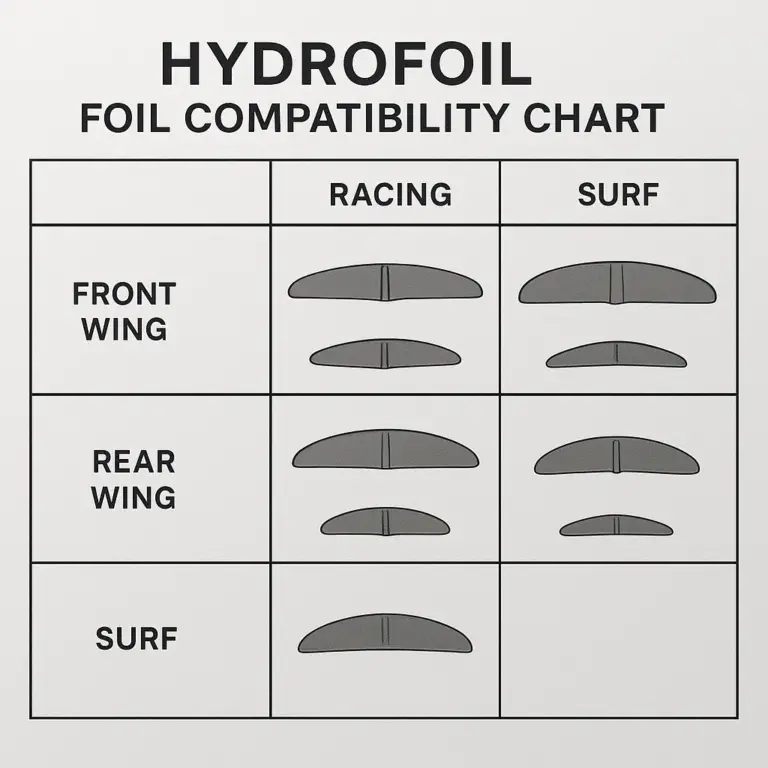
A larger, lower-aspect wing generally offers easier lift and a more forgiving feel. A narrower, higher-aspect wing can provide greater glide and efficiency but may demand more precise control. The exact result depends on the shape and the complete setup.
In practical terms:
- Newer riders usually benefit from a stable board and a forgiving wing.
- Experienced riders may prefer smaller boards or more performance-oriented wings.
- Changing the wing can transform the ride more than changing a spec-sheet top speed.
- Follow the manufacturer’s wing and stabilizer pairings. Mixing parts without compatibility guidance can compromise fit and handling.
How We Review and Compare Electric Hydrofoil Boards 🔍
We compare eFoils by looking beyond the marketing label. A model called “Pro” may be excellent for an experienced rider but a poor first board for someone still learning to stand. Likewise, a generous battery rating does not promise the same runtime for every rider.
The ratings below are editorial comparison scores, not lab measurements or claims of personal testing on every board. They reflect published reviews, stated design goals, publicly available specifications, and practical considerations for choosing a complete system.
Ride feel, stability, and beginner friendliness
We look at:
- Board volume and shape, with rider weight and skill level in mind
- How forgiving the board and foil appear for takeoff and landing
- Whether the model offers rider-assistance features
- Whether the brand provides alternate wings or stable beginner setups
- How well a setup can support progression after the first sessions
The Inertia’s testers found the Waydoo Flyer EVO Pro Plus’s Flight Assist useful, while also reporting that novice riders could make progress without relying on it. That’s a helpful distinction: assistance may reduce early frustration, but it can’t substitute for proper coaching and practice.
Battery range, charging, and real-world ride time
Battery runtime depends on more than the battery label. Rider weight, selected speed, water conditions, foil efficiency, repeated takeoffs, temperature, battery age, and riding style all influence energy use. A relaxed cruising session and a session full of hard accelerations are not equivalent tests.
A responsible comparison should ask:
- What battery options fit this board?
- Can the battery be removed safely for charging and carrying?
- What does the manufacturer state about care and charging?
- Are test conditions and rider details disclosed?
- Is there a clear low-battery warning or return plan?
Build quality, service, and warranty
An eFoil is a high-value, electrically powered piece of water equipment. We recommend checking the warranty terms, local dealer access, battery support, replacement parts, and service procedure—not only the carbon finish or display screen.
The U.S. Consumer Product Safety Commission’s lithium-ion battery safety guidance is useful general reading. Always follow the exact charging, storage, inspection, and transport instructions supplied by the eFoil maker.
10 Electric Hydrofoil Boards Reviewed and Compared 🏆
1. Lift5 eFoil: Refined Performance and Customization
| Aspect | Rating / 10 |
|---|---|
| Design | 9 |
| Functionality | 9 |
| Ride versatility | 9 |
| Beginner friendliness | 8 |
| Performance potential | 9 |
| Service and upgrade ecosystem | 9 |
| Overall editorial score | 9 |
Lift5 eFoil on Lift’s official site — check the current model lineup and configurations, since board and foil packages may vary by region and release.
Best for: Riders who value established eFoil design, component choices, and room to progress.
Lift has built a strong reputation in electric foiling, and the brand’s larger ecosystem is a notable advantage. Lift’s product family has included multiple board sizes and foil options, giving riders a way to choose between greater stability and a more compact, performance-oriented ride. In The Inertia’s review of Lift’s lineup, testers praised the broader foil options and noted that compatible Lift foils can also be used for non-electric foiling.
What stands out
- Multiple board sizes and foil options across the lineup
- A performance range that can suit learning through advanced riding
- The optional Blowfish inflatable add-on, which can increase stability and buoyancy on compatible setups
- Potential compatibility with other Lift foil equipment, depending on the specific configuration
Trade-offs
- A large catalog can make the right setup less obvious for a first-time buyer.
- Compact performance boards demand more balance and skill.
- Verify compatibility and availability of components for the exact generation you’re considering.
Our take: Lift is a compelling choice if you want a brand with a broad foil ecosystem and expect to care about progression and setup changes. Beginners should choose the stable configuration first; you can always go smaller later.
👉 CHECK PRICE on: Lift eFoil search on Amazon | Lift Foils Official Website
2. Fliteboard Series 5: A Versatile Premium eFoil
| Aspect | Rating / 10 |
|---|---|
| Design | 9 |
| Functionality | 9 |
| Ride versatility | 9 |
| Beginner friendliness | 8 |
| Performance potential | 9 |
| Service and upgrade ecosystem | 9 |
| Overall editorial score | 9 |
Fliteboard official site — confirm current Series 5 specifications, battery choices, and package compatibility directly with Flite.
Best for: Riders seeking a premium system with multiple board styles, battery choices, and foil configurations.
Flite’s strength is the breadth of its lineup. The brand offers different approaches for riders who want a stable all-around board, a softer-sided option, or a compact setup. The Inertia’s hands-on reviewers gave Flite a slight edge for its variety of board designs and sizes, while recognizing Lift as a strong rival for component choice and performance.
What stands out
- Multiple board formats and accessory options
- A lineup that can serve beginners and experienced riders
- Brand support and dealer network cited positively independent review coverage
- A well-developed range of battery and foil configurations
Trade-offs
- The number of packages can make comparisons confusing.
- The most compact performance models are not the obvious choice for a first session.
- Battery compatibility varies by board and setup; don’t assume every pack fits every model.
Our take: Flite is among the strongest all-around candidates if you want a system that can evolve with your riding. Ask the dealer to quote the complete setup: board, battery, mast, foil, charger, remote, and any required accessories.
👉 CHECK PRICE on: Fliteboard search on Amazon | Fliteboard Official Website
3. Flite Air Pro: An Inflatable, Travel-Friendly eFoil
| Aspect | Rating / 10 |
|---|---|
| Design | 8 |
| Functionality | 8 |
| Durability for mixed use | 9 |
| Beginner friendliness | 9 |
| Portability | 8 |
| Performance potential | 7 |
| Overall editorial score | 8 |
Flite Air range — consult Flite’s official materials for current Air and Air Pro specifications.
Best for: Newer riders, families, and people who value a forgiving, more impact-friendly board feel.
The Inertia review called the Flite Air a strong value proposition among its tested eFoils, praising its beginner-friendly construction and versatility. Its Air Pro testing notes describe an inflatable outer section over a rigid core, combining a softer surface with structural support. That can be appealing when learning involves clumsy board handling—as it often does.
What stands out
- Soft-sided construction can be friendlier during handling and falls
- A more approachable feel for new riders than many compact hard boards
- The Air range offers more than one size and construction style
- Can be a practical option for shared family use, depending on rider size and setup
Trade-offs
- A soft-sided design may feel less hydrodynamic than a hard board.
- Takeoffs and touchdowns may feel stickier than on a streamlined rigid board.
- The Inertia review reports that certain larger battery options do not fit the Air Pro; verify current compatibility before buying.
Our take: The Air Pro is worth a close look if stability and a forgiving exterior matter more than maximum agility. A softer board will not make the foil magically harmless, so keep your safety habits sharp.
👉 CHECK PRICE on: Flite Air eFoil search on Amazon | Fliteboard Official Website
4. Waydoo Flyer EVO Pro Plus: Feature-Rich and Modular
| Aspect | Rating / 10 |
|---|---|
| Design | 8 |
| Functionality | 9 |
| Beginner friendliness | 9 |
| Rider-assistance features | 9 |
| Upgrade flexibility | 8 |
| Performance for advanced riding | 7 |
| Overall editorial score | 8 |
Waydoo Flyer EVO — check the official page for current board, battery, wing, and assistance configurations.
Best for: Beginners and intermediates who appreciate durable construction and optional learning assistance.
The Flyer EVO family has included Max, Pro, and Master board sizes, with certain Plus configurations offering Flight Assist. In The Inertia’s review, riders appreciated the system’s added takeoff and balance assistance. The testers also found that new riders could make progress without it, so treat assistance as a useful aid—not a substitute for good fundamentals.
What stands out
- Several board sizes aimed at different rider needs
- Durable EPP construction on relevant models
- Flight Assist on applicable Plus versions
- Practical details reported by reviewers, including a battery status display and magnetic power control
Trade-offs
- Current foil choices may be narrower than those from more established component ecosystems.
- Reviewers found some larger-wing setups stable but less agile for experienced riders.
- Check the exact model: Flyer One+, Flyer EVO, and EVO Plus versions are not interchangeable names for a single unchanged product.
Our take: Waydoo is a sensible shortlist option if you want an accessible learning setup and useful technology. Ask the seller to identify the precise generation, battery, wing, and assistance package in writing.
👉 CHECK PRICE on: Waydoo Flyer eFoil search on Amazon | Waydoo Official Website
5. Awake VINGA 3: A Compact, Responsive Electric Foil
| Aspect | Rating / 10 |
|---|---|
| Design | 9 |
| Functionality | 8 |
| Ride responsiveness | 8 |
| Beginner friendliness | 7 |
| Performance potential | 8 |
| Service and support | 8 |
| Overall editorial score | 8 |
Awake VINGA — check official product information for the current generation and package details.
Best for: Riders drawn to a sleek, compact system and a more performance-oriented riding style.
The VINGA 3 appears in eFoil reviews and comparison videos as a design-forward model. That design appeal is real, but it should not be your only selection criterion. For new riders, confirm board volume, foil size, and the recommended rider-weight range before falling for the silhouette.
What stands out
- Distinctive, refined styling
- Compact design approach
- A recognizable brand in powered boards and electric watercraft
Trade-offs
- A compact or performance-focused board may be less forgiving to learn on.
- Published third-party testing details are less extensive in the supplied comparison material than for Flite, Lift, or Waydoo.
- Verify current model availability and service coverage in your region.
Our take: Put the VINGA 3 on your shortlist if you prioritize its design and riding character, but compare the complete setup and local support before committing. Pretty hardware is a bonus; reliable parts support is the part you’ll appreciate after a season.
👉 CHECK PRICE on: Awake VINGA eFoil search on Amazon | Awake Official Website
6. SiFly Rider: Smooth, Approachable Foilboarding
| Aspect | Rating / 10 |
|---|---|
| Design | 8 |
| Functionality | 8 |
| Beginner friendliness | 8 |
| Ride smoothness | 8 |
| Performance range | 7 |
| Service and support | 7 |
| Overall editorial score | 8 |
SiFly official website — confirm current Rider specifications and availability.
Best for: Beginners and intermediate riders seeking an approachable all-around package.
The Rider has appeared in multiple eFoil roundups, including the video overview in this article. In The Inertia’s SiFly testing, reviewers described the brand’s Cruiser 130 wing as smooth and progressive, with a friendly lift profile. They also reported occasional battery-door and controller-connection troubleshooting, an observation worth balancing against the positive ride impressions.
What stands out
- An accessible all-around design
- Smooth, progressive lift reported by testers
- A simpler system approach than some highly customizable lineups
Trade-offs
- Fewer distinctive features than some competitors, according to independent test coverage.
- Confirm battery connection and door-seal procedures with your dealer.
- Check which wing and board configuration is being reviewed; “SiFly Rider” alone does not tell the whole setup story.
Our take: SiFly Rider looks like a reasonable option for riders who want an uncomplicated, approachable eFoil. Before buying, ask about regional service and how to troubleshoot the battery and controller connection.
👉 CHECK PRICE on: SiFly Rider eFoil search on Amazon | SiFly Official Website
7. SiFly Stellar: Lightweight Design and Agile Handling
| Aspect | Rating / 10 |
|---|---|
| Design | 8 |
| Functionality | 8 |
| Ride smoothness | 8 |
| Beginner friendliness | 7 |
| Performance potential | 8 |
| Upgrade flexibility | 7 |
| Overall editorial score | 8 |
SiFly Stellar range — check the official site for current board sizes and foil packages.
Best for: Riders looking for a carbon-board option with an approachable all-around foil feel.
The Inertia’s testers rode a 98 L Stellar S and described SiFly’s Cruiser 130 wing as stable, smooth, and progressive. Their review considered SiFly a solid choice for beginner and intermediate riders, while noting that it offers fewer standout innovations than some rivals.
What stands out
- Carbon construction on relevant Stellar models
- A smooth ride feel reported by reviewers
- A straightforward choice for riders who value simplicity
Trade-offs
- Board size and stability still need to match the rider.
- The product family includes different capacities and constructions, so confirm the exact version.
- There may be fewer customization paths than in larger ecosystems.
Our take: Stellar is worth considering if its board construction and smooth riding characteristics suit your priorities. Compare it with SiFly Rider and other models using the same rider-weight and wing assumptions.
👉 CHECK PRICE on: SiFly Stellar eFoil search on Amazon | SiFly Official Website
8. Audi e-tron foil by Aerofoils: Premium German Engineering
| Aspect | Rating / 10 |
|---|---|
| Design | 9 |
| Functionality | 8 |
| Construction appeal | 9 |
| Beginner friendliness | 7 |
| Performance potential | 8 |
| Independent review depth | 7 |
| Overall editorial score | 8 |
Aerofoils official website — verify current product naming, specifications, and regional support.
Best for: Riders attracted to a premium design identity and the Aerofoils system.
The Audi e-tron foil by Aerofoils has appeared in eFoil product comparisons and review videos as a polished, engineering-led option. That’s a useful starting point, but brand association should not replace practical checks: board volume, battery system, foil fit, warranty, and local service matter on the water.
What stands out
- Premium visual design
- A product identity linked to Audi and Aerofoils
- Included independent eFoil comparison coverage
Trade-offs
- The provided comparison summaries contain less detailed hands-on performance data than for some leading test picks.
- Confirm exactly which model year and package a review covers.
- Check regional parts and service availability before buying.
Our take: Consider it if the complete system and support match your needs—not simply because the badge looks sharp. An eFoil’s most important engineering feature is the one that gets you safely back to shore.
👉 CHECK PRICE on: Audi e-tron foil search on Amazon | Aerofoils Official Website
9. LiftX eFoil: A Compact Board for Travel and Progression
| Aspect | Rating / 10 |
|---|---|
| Design | 8 |
| Functionality | 8 |
| Portability | 8 |
| Beginner friendliness | 6 |
| Performance potential | 8 |
| Setup flexibility | 8 |
| Overall editorial score | 8 |
Lift Foils product range — Lift has offered several board formats over time; confirm the current availability and official model naming for compact boards.
Best for: Experienced riders seeking a smaller, more portable setup.
Compact eFoils can be appealing when storage, transport, and tight turns matter. But small boards typically demand more balance and precise handling. A smaller board may also be harder to launch, stand on, or manage in rough conditions.
What stands out
- Compact-format appeal for experienced riders
- Potentialy easier storage and handling than larger boards
- Lift’s broader foil ecosystem may be relevant to riders already using compatible Lift components
Trade-offs
- Less forgiving for beginners
- Model naming and availability can change; verify directly with Lift
- A compact board is not automatically lighter once battery and foil are included
Our take: Choose a small board only if your current skills justify it. The Inertia’s buying advice is sensible here: don’t downsize just because a smaller board looks more exciting. Progress when your existing setup is genuinely limiting you.
👉 CHECK PRICE on: Lift compact eFoil search on Amazon | Lift Foils Official Website
10. Takuma Cruising: A Stable Setup for Learning to eFoil
| Aspect | Rating / 10 |
|---|---|
| Design | 7 |
| Functionality | 7 |
| Beginner friendliness | 8 |
| Ride stability | 8 |
| Performance potential | 7 |
| Current support and availability | 6 |
| Overall editorial score | 7 |
Takuma official website — confirm current eFoil availability, regional support, and parts before purchase.
Best for: Riders considering a used or locally available setup who can verify its condition and support.
Takuma has appeared in electric hydrofoil discussions and older product roundups, but current availability and service support can vary by region. That makes it especially important to distinguish an attractive used-board listing from a supported, ready-to-ride system.
What to inspect
- Battery health and charging history
- Motor, controller, remote, and safety cutoff operation
- Mast and foil mounting hardware
- Seals, connectors, and evidence of water ingress
- Availability of replacement parts and qualified service
Trade-offs
- Independent current-generation test coverage is limited in the sources summarized here.
- Parts and service availability deserve special attention.
- A second-hand battery can materially affect usability and range.
Our take: Treat this as a condition-and-support purchase, not a blind brand purchase. If a seller cannot demonstrate the system working safely on water, budget for a professional inspection—or walk away.
👉 CHECK PRICE on: Takuma eFoil search on Amazon | Takuma Official Website
Electric Hydrofoil Board Comparison: Specs and Ride Character 📊
Specifications differ by model generation and package. The table below is a selection guide, not a universal spec sheet; verify exact dimensions, included parts, battery options, and compatibility on each manufacturer’s site.
| Brand or model family | General positioning | Beginner appeal | Progression potential | Best-known consideration |
|---|---|---|---|---|
| Lift eFoil | Broad, performance-capable ecosystem | High with a stable setup | High | Board and foil choices; compatibility varies by generation |
| Fliteboard | Broad lineup with several board formats | High with the right board | High | Wide range of configurations and battery options |
| Flite Air / Air Pro | More forgiving, soft-sided format | High | Moderate to high | Construction and battery compatibility differ from hard boards |
| Waydoo Flyer EVO | Feature-rich, modular system | High | Moderate | Check exact Plus features and wing package |
| Awake VINGA | Slek, compact, performance-focused | Moderate | High | Confirm size and local support |
| SiFly Rider / Stellar | Approachable all-around choices | High | Moderate | Verify board, wing, and battery version |
| Audi e-tron by Aerofoils | Premium design-led option | Moderate | Moderate to high | Compare service network and current package details |
| Foil Drive Assist Max | Electric assistance for existing foil gear | Low for complete beginners | High for existing foilers | Requires compatible board, mast, foil, and riding skills |
Best eFoils for beginners, experienced riders, and travel
- Best first-ride shortlist: Flite Air, Waydoo Flyer EVO, SiFly Rider, or a stable Lift configuration.
- Best broad setup ecosystem: Fliteboard and Lift, subject to local dealer support and current compatibility.
- Best for existing foil riders: Foil Drive or another foil-assist system, if you already have compatible foiling equipment.
- Best compact-format direction: A small Lift or Flite performance setup, but only for riders with suitable skills.
- Best feature-assisted option: Waydoo Flyer EVO Plus configurations that include Flight Assist.
The Inertia review identifies Flite Air, Waydoo Flyer EVO, and Lift with Blowfish as beginner-friendly options. That’s not a universal ranking: a heavier rider, a choppy riding location, or a different local service network may change the best choice.
Board volume, rider weight, and foil sizing explained
Volume offers a rough way to compare board buoyancy, but it is not a complete measure of stability. Board width, thickness distribution, shape, foil size, and rider technique all contribute.
The Inertia review gives a beginner rule of thumb of roughly 20–30 litres above rider weight in kilograms. Treat this as a starting point for conversation with a dealer, not a rigid formula. A 180 lb (about 82 kg) rider might investigate a board around 100–110 L, but riding ability and intended conditions can shift the recommendation.
| Rider situation | General direction to discuss with a dealer |
|---|---|
| First-time eFoiler | More volume and a stable, forgiving wing |
| Intermediate rider | Moderate volume with room to experiment with wings |
| Experienced rider | Smaller board or faster wing if skills and conditions support it |
| Heavier rider or rougher conditions | Prioritize usable stability, buoyancy, and manufacturer guidance |
For more setup guidance, see our Hydrofoil Board Selection resources.
How to Choose the Best Electric Hydrofoil Board for You 🛒
Matching an eFoil to your skill level and riding style
Start with how you will actually ride, not how you hope to ride after a year.
- First-time rider: choose stability, an accessible learning setup, and a clear local service path.
- Intermediate rider: consider whether you value smooth cruising, playful turns, or a wider selection of wings.
- Advanced foil rider: a compact board or foil-assist system may make more sense than a large beginner eFoil.
- Family or shared use: prioritize adjustable or stable configurations and make sure every rider’s weight falls within the manufacturer’s recommendations.
- Boat or yacht use: check how the full system stores and launches, including the battery and charging setup.
A board can be excellent on paper and wrong for your water. Calm lakes, tidal currents, crowded beaches, and windy coastal locations each change the equation.
Choosing board size, mast length, and wing setup
- Check the manufacturer’s rider guidance. Use the actual board model and rider weight, not a generic brand recommendation.
- Choose a stable board for learning. A beginner is usually better served by enough volume and width to make kneling, standing, and repositioning manageable.
- Match the wing to your goal. A more forgiving wing can aid early lift; a smaller or higher-aspect wing may suit riders seeking speed and glide.
- Consider mast length. Shorter masts can reduce the height of early flights. Longer masts can help in chop and when carving, but demand confident control.
- Confirm system compatibility. Ask the manufacturer or dealer to verify mast, fuselage, front wing, stabilizer, motor, battery, and board compatibility.
The Inertia review describes common mast lengths in the approximate 70–90 cm range, with shorter lengths often easier for learning and longer lengths useful in chop and turns. Exact suitability varies by system.
Battery options, range claims, and replacement considerations
Battery claims deserve careful reading. Ask whether the stated range is a manufacturer estimate or a measured ride, what rider weight and conditions were used, and whether the test involved frequent acceleration.
Battery checklist before purchase:
- Exact battery capacity and compatible board models
- Charging time and charger included
- Battery weight and safe carrying method
- Storage and maintenance instructions
- Warranty coverage and replacement availability
- Whether the battery can be serviced locally
- How the remote displays remaining charge and system warnings
Do not plan a ride around the most optimistic runtime number. Keep enough reserve to return safely, and use the manufacturer’s battery guidance.
New versus used eFoil boards: What to inspect
Used eFoils can be attractive, but the battery and electronics are not easy to judge from a glossy listing.
Before buying used:
- Ask for battery age, charge history, and any service records.
- Inspect battery seals, connectors, and compartment for corrosion or moisture.
- Check the mast, board mounts, foil, and propeller for cracks, damage, or bent hardware.
- Test the remote, safety cutoff, motor, and display according to the brand’s safe procedure.
- Confirm the charger and every required component are included.
- Check that the model is still supported and parts are available.
- Arrange a supervised water test or professional inspection where possible.
✅ Good sign: The seller can identify the exact generation and demonstrate the complete system.
❌ Walk-away sign: “It worked last summer,” paired with a missing charger or an unverified battery.
Battery Life, Charging, and Electric eFoil Running Costs 🔋
Battery runtime is one of the most misunderstood eFoil specifications. Published reviews report that some larger setups can exceed an hour under suitable conditions, but that is not a guarantee for every rider or session. A heavier rider, high speed, repeated takeoffs, chop, and an older battery can all shorten runtime.
| Runtime factor | Typical effect |
|---|---|
| Rider weight | More load can require more power |
| Speed and acceleration | Faster riding and repeated bursts use energy more quickly |
| Foil efficiency | A well-matched foil can reduce the effort needed to maintain flight |
| Water and wind conditions | Chop, current, and headwinds may increase power demand |
| Battery age and care | Capacity can decline over time; follow the maker’s maintenance instructions |
| Riding style | Smooth cruising and repeated hard takeoffs have different energy demands |
A practical charging routine
- Read the board and battery manual before charging.
- Inspect the battery, charger, connector, and seals for damage or moisture.
- Charge only as instructed by the manufacturer, using the correct charger.
- Keep batteries away from heat, water, and combustible materials.
- Store and transport batteries according to the brand’s guidance.
- Stop using a battery that is swollen, damaged, unusually hot, or behaving abnormally; contact the manufacturer or a qualified service provider.
For general lithium-ion precautions, consult the U.S. CPSC battery safety guidance. For eFoil-specific instructions, the manufacturer’s manual takes priority.
eFoil Setup, Transport, Storage, and Maintenance 🧰
Most complete eFoil setups are substantial loads. The Inertia review notes that many assembled systems fall in a broad 50–80 lb range, with compact setups sometimes lighter. Actual weight varies by board, battery, mast, foil, and accessories. Remove the battery before carrying only if the manufacturer’s process allows it and you can do so safely.
Pre-ride setup checklist
- Choose a permitted, suitable launch spot. Check water depth, traffic, and local rules.
- Inspect the board and foil. Look for cracks, loose hardware, or damage.
- Check battery seals and connectors. Keep the battery compartment clean and dry.
- Confirm the remote and safety cutoff work. Follow the manufacturer’s procedure.
- Fit protective gear. Wear a helmet and appropriate impact vest or PFD.
- Set a conservative riding area. Keep well clear of swimmers, docks, rocks, and other craft.
- Plan your return. Know your launch point and keep a reserve of battery.
After-ride care
- Rinse equipment with fresh water where the manufacturer recommends it.
- Dry the battery compartment and connectors before closing or storing.
- Inspect foil hardware and propeller or jet components.
- Check seals, screws, and fasteners according to the manual.
- Store the battery under the manufacturer’s specified conditions.
- Arrange qualified servicing when you see corrosion, damage, unusual noise, or electrical faults.
For more gear guidance, see our Hydrofoil Equipment Reviews and Hydrofoil Brands Comparison.
Electric Hydrofoil Safety: Lessons for New Riders 🛟
An eFoil combines an electric motor with a sharp underwater foil. Respect both. A kill switch helps stop propulsion if the rider falls or separates from the remote, but it does not make collisions, shallow water, or careless handling safe.
What happens if you fall off an eFoil?
The motor should stop when the safety system activates, but confirm the exact behavior for your model before riding. After a fall:
- Keep clear of the board and foil. Do not swim toward the mast or propeller.
- Check that propulsion has stopped. Follow your model’s safety procedure.
- Regain control of the board carefully. Approach from a safe position and avoid the foil.
- Check yourself and your gear. Stop riding if you are injured or the board is damaged.
- Return conservatively. Do not ignore a low-battery warning or worsening conditions.
Learn to fall away from the board and avoid reaching blindly beneath it. If you’re new, practise in a clear, supervised area with enough depth and room.
Protective gear, remote controls, and safe riding zones
- Wear a helmet designed for water sports and a suitable impact vest or PFD.
- Use the manufacturer’s safety key, leash, or cutoff system as directed.
- Keep a wide distance from swimmers, other riders, boats, docks, and shoreline hazards.
- Avoid shallow water: the foil extends below the board.
- Do not arm the motor while on land or while people are handling the foil.
- Check local rules before riding; powered-foil classifications vary across jurisdictions.
In open water, plan for communication and recovery. A waterproof phone pouch, location sharing, or a suitable marine communication device may be appropriate depending on the location and conditions.
Learning to eFoil: First-ride tips and common mistakes
A sensible learning sequence:
- Practise throttle control and board handling on land with the motor disabled.
- Start in calm, open water under qualified instruction if available.
- Begin kneling and use gentle, steady throttle.
- Learn to keep your weight centered and your gaze ahead.
- Progress to standing only when you can control the board consistently.
- Make small throttle changes; abrupt acceleration often creates avoidable instability.
- Stop before fatigue takes over. Tired riders make worse decisions.
Common mistakes include choosing a board that is too small, looking down at the board, making sudden throttle inputs, and riding too close to shore. Our Advanced Hydrofoiling Techniques category is better suited once you have reliable control and safe fundamentals.
Where and When to Ride an Electric Hydrofoil Board 🌬️
Efoils can work on lakes, sheltered bays, and suitable coastal water, but “no waves needed” does not mean “any water is fine.”
Wind, waves, water depth, and weather conditions
Before launching, assess:
- Water depth: The foil needs clearance beneath the board throughout the ride.
- Wind and current: These can make returning harder than the outward ride.
- Waves and chop: Conditions affect balance, visibility, and power demand.
- Traffic and visibility: Stay out of busy channels and give other water users plenty of space.
- Weather and rescue options: Don’t ride beyond your skill, equipment, or ability to return safely.
Beginners generally benefit from calm, open water with minimal traffic. Advanced riders may seek chop or swell, but conditions that look exciting from shore can become demanding once the board is airborne.
Local rules, permits, and access considerations
Regulations differ by country, state, and local waterway. Some authorities treat powered foilboards differently from ordinary surfboards or non-powered foilboards. Check with the local marine agency, harbor authority, park service, or waterbody manager.
In the United States, the U.S. Coast Guard’s boating safety resources provide general boating guidance, but local rules and classification requirements still need to be confirmed for your location. Never assume a beach or lake that permits surfing automatically permits motorized eFoiling.
eFoil Boards vs. Surfboards, SUPs, and Other Foilboards ⚖️
| Board type | Propulsion | Needs waves or wind? | Main appeal | Main limitation |
|---|---|---|---|---|
| Traditional surfboard | Waves | Usually yes | Simple, light, wave-driven surfing | Dependent on surf conditions |
| Stand-up paddleboard | Paddle | No | Versatile exercise and flat-water access | Requires paddling effort |
| Non-powered foilboard | Waves, wing, kite, or tow | Usually | Foil sensation without onboard motor | Requires another source of energy |
| Dedicated eFoil | Onboard electric motor | No | Powered flight in suitable water | Heavy, costly, battery-dependent |
| Foil-assist system | Electric assist attached to compatible gear | No, but designed around existing foiling | Adaptable for riders with a foil quiver | Setup and learning curve can be higher |
A dedicated eFoil is the most self-contained option. A foil-assist system such as Foil Drive may appeal to an experienced prone, wing, or downwind foiler who already owns compatible equipment. The Inertia review found the Foil Drive Assist Max lighter than a typical complete eFoil in its tested configuration, but it is not a plug-and-play beginner board.
Electric Hydrofoils: Noise, Emissions, and Environmental Considerations 🌱
Electric propulsion avoids direct exhaust at the riding location, and eFoils can be quieter than many motorized watercraft. That does not mean they have zero environmental footprint: battery production, electricity generation, transport, maintenance, and end-of-life disposal all matter.
Responsible riding includes:
- Follow local wildlife, protected-area, and no-wake rules.
- Keep clear of nesting sites and sensitive habitats.
- Avoid disturbing other water users with repeated close passes.
- Maintain the motor and battery to prevent leaks or avoidable waste.
- Use manufacturer-approved battery recycling or disposal channels where available.
- Choose a suitable riding area rather than assuming quiet propulsion permits access everywhere.
Quiet can be considerate, but it can also make an approaching board harder for swimmers to hear. Keep generous distance and ride predictably.
Electric Hydrofoil Board Reviews: Frequently Asked Questions ❓
What maintenance is required for electric hydrofoil boards?
Rinse and dry the equipment as directed by the manufacturer, inspect the foil and drive for damage, maintain fasteners and seals, and follow the battery’s specific charging and storage instructions. If a connector, motor, battery, or safety cutoff behaves unusually, stop using the board and contact the brand or a qualified service provider.
Which checks matter most after a ride?
Pay particular attention to battery seals and connectors, foil mounting hardware, and the propeller or jet assembly. A small inspection routine is easier than discovering a damaged seal at the launch ramp.
How fast can electric hydrofoil boards go on average?
There is no useful single “average” that applies across board designs, rider skills, and regional configurations. Manufacturers and reviewers may publish different speed figures based on different setups and conditions. For most riders, control, safe distance, and local rules matter more than chasing a maximum number. The Inertia reviewers put it bluntly: for many buyers, eFoils are “faster than you want to.”
What should you use speed figures for?
Use them to compare intended performance categories, not to plan a ride around a claimed maximum. Confirm the legal and safe operating conditions where you intend to ride.
Which brands offer the most reliable electric hydrofoil boards?
Flite and Lift receive substantial attention independent comparison reviews for their established product ecosystems and range of configurations. Waydoo, SiFly, Awake, and Aerofoils also offer products worth comparing. Reliability depends on the exact model, maintenance, battery condition, and regional service support—not just brand reputation.
What support questions should you ask?
Ask where repairs are performed, which replacement parts are stocked, how battery issues are handled, and whether the warranty applies in your location.
Are electric hydrofoil boards safe for kids and beginners?
They can be ridden by appropriately prepared beginners under suitable conditions and supervision, but they are not toys. A powered board, foil, and battery require careful instruction, protective gear, a safe riding area, and compliance with local rules. For children, follow the manufacturer’s minimum-age and weight guidance and consult a qualified instructor and guardian.
What makes a beginner setup safer and easier?
A stable board, forgiving wing, slow and predictable throttle control, open water, and instruction help. A safety cutoff is essential equipment, not permission to ride close to people.
What is the average battery life of an electric hydrofoil board?
“Battery life” can mean ride time per charge or long-term lifespan. Ride time varies with rider weight, speed, water conditions, foil efficiency, and battery health. The Inertia review reports test sessions exceeding an hour on larger batteries, but actual results will differ. Long-term battery lifespan depends on use, storage, charging, and manufacturer guidance; check the warranty and replacement support for the exact battery.
How can you get a more realistic range estimate?
Ask for test conditions, including rider weight, battery configuration, speed, and whether the figure comes from a manufacturer estimate or a documented ride. Leave a reserve rather than planning to use every last percent.
How do electric hydrofoil boards compare to traditional surfboards?
An eFoil supplies its own propulsion and can ride without waves, while a traditional surfboard relies on surf conditions and wave energy. Efoils are heavier, more complex, and battery-dependent; surfboards are simpler and generally easier to transport. They offer different experiences, not a direct replacement for one another.
What are the best electric hydrofoil boards for beginners?
The Flite Air, Waydoo Flyer EVO, SiFly Rider, and a suitably stable Lift configuration are good models to investigate. The right choice depends on rider weight, water conditions, instructor access, local support, and the exact board-and-wing package.
Should beginners buy a board with assistance features?
Assistance can help, but it should be treated as an aid rather than a requirement. Ask whether the feature is included in the exact version and how it affects the learning experience.
Which electric hydrofoil board has the best reviews?
There is no universally agreed winner. The Inertia’s hands-on review highlights Flite for breadth and versatility, Lift for a strong component ecosystem, Flite Air for beginner-friendly value, Waydoo Flyer EVO for feature-rich learning, and SiFly Stellar as a smooth all-around choice. Those are different strengths, not a single objective podium.
Why do review rankings conflict?
Reviewers may test different model years, wings, batteries, riders, water conditions, and price categories. A beginner-focused review and an advanced wave-riding review can reasonably select different winners.
How much does a highly rated electric hydrofoil board cost?
Efoils are substantial equipment purchases, and complete setups can range from several thousand dollars to well into the five-figure category depending on brand, board, battery, and options. We’re not listing specific prices because packages and regional costs change. Request a complete written quote that includes every required component, shipping, taxes, and likely service needs.
What costs are easy to overlook?
Consider batteries, chargers, repairs, replacement parts, protective equipment, transport, storage, and any local registration or access requirements.
Are electric hydrofoil boards worth the investment?
They may be worth it if you have frequent access to suitable water, value powered flight without waiting for waves or wind, and are comfortable maintaining a complex electric system. They may not be worth it if you’ll ride rarely, have no practical charging or storage setup, or expect an eFoil to be as simple to transport as a surfboard.
What should I look for when comparing electric hydrofoil board reviews?
Check the model year, rider weight, board volume, foil, mast, battery, conditions, test method, and whether the reviewer rode the product or only summarized specifications. Also look for service and warranty information. A clear, limited test is more useful than an unsupported superlative.
How do electric hydrofoil boards compare in speed and range?
Speed and range move with the complete setup. A rider’s mass, foil efficiency, battery size, water conditions, and chosen speed can all affect both. Larger batteries may extend runtime but add weight; high-speed riding typically consumes more energy. Compare tests only when the conditions and configurations are reasonably similar.
Is Foil Drive a beginner alternative to a dedicated eFoil?
Usually not as a first step. Foil Drive and similar assist systems are designed for compatible foil gear and may best suited to people who already understand prone, wing, or downwind foiling. A dedicated eFoil is generally a more integrated starting point for powered foilboarding.
What is the eFoilFly NEPTUN X?
A forum video review of the eFoilFly NEPTUN X features eFoilFly representatives Paul and Alvaro discussing the board, remote, safety magnet, indicators, battery, and water testing. The available forum summary does not provide enough specifications or test data to rate it against the models above, so treat it as a useful introduction rather than a complete comparative review.
What should you verify before considering it?
Confirm current specifications, battery and wing compatibility, independent ride-test details, warranty, parts access, and service availability with the brand or seller.