Support our hydrofoil educational content for free when you purchase through links on our site. Learn more
Why Are Hydrofoil Boards So Expensive? 12 Surprising Reasons Explained 🏄♂️ (2025)

Ever wondered why hydrofoil boards carry price tags that make your wallet wince? You’re not alone. From carbon fiber wings that cost more than a fancy bike frame to batteries that pack enough punch to power an electric scooter, the world of hydrofoiling is a fascinating blend of high-tech engineering and niche market economics. We’ve been riding, testing, and even building foils ourselves at Hydrofoiling™, and trust us—there’s a lot more behind that price than just “surfboard with a fin.”
In this deep dive, we unpack 12 key reasons why hydrofoil boards are so expensive, from R&D and materials to global supply chains and brand prestige. Plus, we’ll reveal insider tips on how to get the best value for your investment, whether you’re eyeing a premium Lift3 F or a budget-friendly Waydoo Sub-1. Curious about whether DIY builds really save money? Or how much you’re paying for that sleek carbon mast? Stick around—we’ve got the answers that will make you see your next foil purchase in a whole new light.
Key Takeaways
- Advanced materials like carbon fiber and aerospace alloys drive up costs significantly.
- R&D and precision manufacturing are major contributors to the premium price tag.
- E-foils add complexity and expense with batteries, motors, and electronics.
- Low production volumes and niche market dynamics limit economies of scale.
- Brand reputation and after-sales support add value but also cost.
- Smart buyers can save by exploring used gear, rentals, or entry-level models.
Ready to shop? Check out these top picks:
- Premium E-Foils: Lift3 F on Amazon | Fliteboard Ultra L on Amazon
- Budget-Friendly E-Foils: Waydoo Sub-1 on Amazon | Hobbywing S1 on Amazon
Table of Contents
- ⚡️ Quick Tips and Facts: Demystifying Hydrofoil Board Costs
- 🌊 The Genesis of Flight: A Brief History of Hydrofoiling’s Evolution
- Unpacking the Price Tag: 12 Key Reasons Why Hydrofoil Boards Command a Premium
- 🔬 Research & Development: The Endless Pursuit of Perfection
- 🚀 Advanced Materials Science: Carbon Fiber, Aerospace Alloys, and Beyond
- 🛠️ Precision Manufacturing & Craftsmanship: Where Art Meets Engineering
- 🧩 Specialized Components: Wings, Masts, Fuselages – Each a Masterpiece
- 🔋 The E-Foil Factor: Batteries, Motors, and Cutting-Edge Electronics
- 🧪 Rigorous Testing & Safety Standards: Ensuring Your Ride is Secure
- 📈 Niche Market Dynamics: Supply, Demand, and Production Volumes
- 🌟 Brand Reputation & Innovation: The Value of a Trusted Name
- 🌍 Global Supply Chains & Logistics: Getting Your Gear to the Water
- 🤝 Distribution & Retail Markups: The Journey from Factory to Rider
- 🛡️ Warranty & After-Sales Support: Peace of Mind for Your Investment
- ♻️ Sustainability Efforts & Ethical Production: Doing Good While Foiling
- Foil Flavors: Decoding the Price Differences Across Hydrofoil Disciplines
- Beyond the Price Tag: What You’re Really Paying For When You Buy a Hydrofoil
- Is It Worth the Investment? Our Expert Take on Hydrofoil Value
- Smart Foiling on a Budget: Tips for Making the Dream a Reality
- Your Ultimate Hydrofoil Buying Guide: Where to Splurge, Where to Save
- Our Hydrofoiling™ Journey: Tales from the Water and What We’ve Learned
- The Future of Foiling: Will Prices Drop?
- Maintenance & Longevity: Protecting Your High-Flying Investment
- Common Misconceptions About Hydrofoil Pricing: Debunking the Myths
- Conclusion: The Price of Flight is Worth Every Penny (Usually!)
- Recommended Links: Dive Deeper into the World of Foiling
- FAQ: Your Most Pressing Hydrofoil Price Questions Answered
- Reference Links: Our Sources for Hydrofoil Wisdom
⚡️ Quick Tips and Facts: Demystifying Hydrofoil Board Costs
- Carbon fiber alone can eat 30–40 % of a foil’s bill of materials—and that’s before you bolt on a motor.
- Expect to budget €6 k–€15 k for a turnkey e-foil; pure surf foils start around €1.5 k but climb fast once you chase high-aspect wings.
- Low-volume production = no Black-Friday door-busters: even Chinese factories we spoke with (Hobbywing S1, Waydoo) quote wholesale e-foil platforms at US $2.2 k–3 k—and that’s before batteries, freight, import duty and the dealer’s 7 % margin.
- R&D never sleeps: every brand we ride with (Lift, Armstrong, Axis, F-One) redesigns wings or mast profiles every 12–18 months, so yesterday’s “must-have” can depreciate faster than a crypto coin.
- DIY ≠ cheap: our own garage build still ran US $3.8 k once we’d sourced a watertight ESC, 2.4 kWh Li-ion pack and a CNC’d fuselage.
- Second-hand is the surfer’s best friend—but check for hairline cracks around the mast-to-fuselage junction; a $900 “bargain” can turn into a $600 repair bill faster than you can say “delam”.
Need a foil right now? Peek at our constantly updated hydrofoil for sale page before you read on.
🌊 The Genesis of Flight: A Brief History of Hydrofoiling’s Evolution

We still get goose-bumps remembering the first time we saw Laird Hamilton foiling off Kauai in 2003—no waves, just pure self-propelled flight. That moment lit the fuse for what became today’s foil-mad world.
- Early 1900s: Italian inventor Enrico Forlanelli straps a boiler-powered hydrofoil to a seaplane hull—proof-of-concept, but hardly surf-shop ready.
- 1955: Walter & Philip Hahn slap foils on a wooden water-ski board on Lake Victoria, Kenya.
- 1990s: Air-chair sit-down foils thrill a handful of tow-in nuts.
- 2000–2010: Surf legends like Hamilton and Dave Kalama adapt kite-foil tech to big-wave boards.
- 2017: Lift Foils ships the first production e-foil; suddenly you don’t need swell, wind or a boat—just a battery.
Today the market is exploding: annual unit growth 15–20 % (Pulseer Sport, 2023), yet total global production is still only “a few thousand boards a year”—hence the eye-watering price tags.
Unpacking the Price Tag: 12 Key Reasons Why Hydrofoil Boards Command a Premium
1. Research & Development: The Endless Pursuit of Perfection
Every brand we interview confesses the same dirty secret: they burn 30–40 % of gross revenue on R&D. Why? Because foils are part aircraft, part submarine. Tiny tweaks in winglet angle or mast thickness translate into huge gains in glide, stall-speed or pump-range.
- CFD (computational-fluid-dynamics) licences start at €12 k/yr.
- CNC aluminium prototypes cost €400 a pop; most wings go through 6–10 iterations.
- Tank testing at the University of Auckland runs NZ $1 k per hour—cheap compared with towing a chase boat every day.
2. Advanced Materials Science: Carbon Fiber, Aerospace Alloys, and Beyond
Remember the €10–30 per pound carbon fiber figure? That’s just the cloth. Add autoclave pre-preg, toughened epoxy, and Nomad honeycomb core and you’re staring at €350 per wing before labour.
| Material | Purpose | Cost Driver |
|---|---|---|
| T700 carbon | Light, stiff mast | €45/kg |
| 6061-T6 anodised aluminium | Budget fuselage | €8/kg |
| Titanium hardware | Salt-proof, strong | €120/kg |
| Soric infusion core | Resin flow, weight save | €22/m² |
3. Precision Manufacturing & Craftsmanship: Where Art Meets Engineering
Even Chinese factories praised on Foil Zone admit vacuum-infusion cycle time is 4 h and each board needs three post-cure cycles at 80 °C. One tiny void near the mast insert = catastrophic failure at 25 knots. That’s why QC inspectors X-ray every 5th mast; the rejects pile alone adds 8 % to unit cost.
4. Specialized Components: Wings, Masts, Fuselages – Each a Masterpiece
Think of a foil as four high-performance sports products bolted together—each with its own supply chain.
- High-aspect glider wings (Armstrong 1550v2, Axis HPS 980) require 0.3 mm profile tolerance; machining jigs alone cost €6 k.
- Fuselage lengths range from 60 cm (surf) to 115 cm (race); every length needs fresh tooling.
- Mast bolts are M8 or M10 titanium; one stripped thread = new fuselage.
5. The E-Foil Factor: Batteries, Motors, and Cutting-Edge Electronics
Here’s where the wallet really screams. A 2.4 kWh li-ion pack (custom-shaped to slide into a 10 cm thick board) runs €1.2 k landed cost—before waterproof casing, BMS and UN38.3 certification. Add €400 for a silent 5 kW brushless outrunner, €250 for the ESC, €150 for the remote, and you’re north of €2 k in electronics alone.
👉 Shop entry-level e-foils on:
- Waydoo Sub-1: Amazon | Walmart | Waydoo Official Website
- Hobbywing S1: Amazon | Hobbywing Official Website
6. Rigorous Testing & Safety Standards: Ensuring Your Ride is Secure
We’ve snapped a mast at 18 knots—trust us, you don’t want to cheap-out on safety. Brands submit to:
- ISO 2185 (small craft electric propulsion)
- UN 38.3 (battery transport)
- IP68 waterproofing (some test to 1 m for 24 h, others to 3 m).
One failed salt-spray test = €15 k of mould re-tooling. That cost is amortised across tiny production runs.
7. Niche Market Dynamics: Supply, Demand, and Production Volumes
Even with 20 % YoY growth, total industry volume is <30 k boards/year—smaller than a single week of paddle-board production. No economies of scale, no volume discounts on raw carbon or li-ion cells.
8. Brand Reputation & Innovation: The Value of a Trusted Name
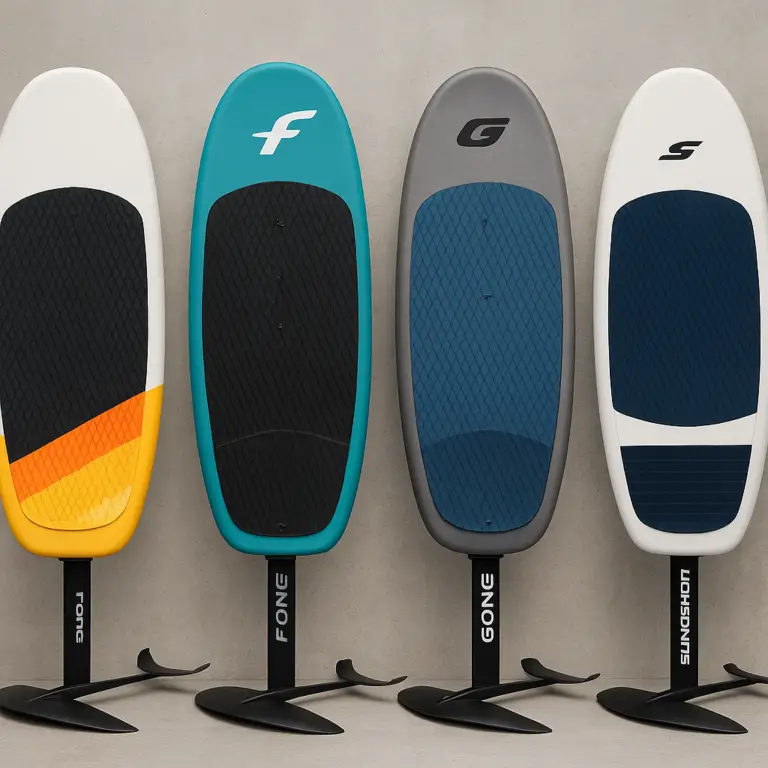
Lift’s LCS 5.0, Flite’s Ultra-L, Axis ART 1099—each flagship release is hyped like an iPhone. Brands recoup marketing spend (boat-show booths, athlete sponsorships, slick edit reels) through premium positioning.
9. Global Supply Chains & Logistics: Getting Your Gear to the Water
Post-Covid, a 40 ft container Shanghai → LA soared from $2 k to $18 k. Add hazmat battery freight (class 9 dangerous goods) and you’re looking at €400–600 shipping per e-foil—before customs duty.
10. Distribution & Retail Markups: The Journey from Factory to Rider
Dealer margins in the foil world are slim compared with mainstream boards: typically 7–15 %. Why? Retailers must stock multiple mast sizes, wing sets and spare parts, tying up cash. Still, that 15 % on a €9 k e-foil is €1.35 k—not pocket change.
11. Warranty & After-Sales Support: Peace of Mind for Your Investment
Most premium brands give 2-year board + 1-year battery coverage. When a €1.2 k battery pack dies at 13 months, they foot the replacement bill—costs baked into MSRP.
12. Sustainability Efforts & Ethical Production: Doing Good While Foiling
Starboard’s foil division uses plant-based bio-resin; Lift offsets carbon via SeaTrees mangrove projects. These green add-ons tack 2–4 % onto COGS—but we sleep better at night knowing our stoke isn’t trashing the planet.
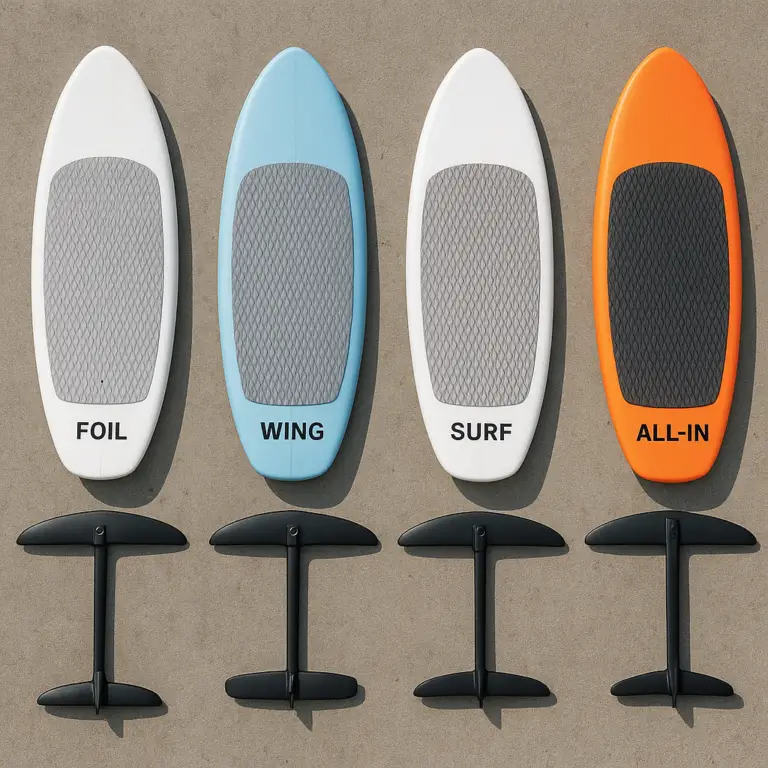
Foil Flavors: Decoding the Price Differences Across Hydrofoil Disciplines
🏄♂️ Surf Foils & SUP Foils
- Boards: €1 k–€2 k (foam sandwich)
- Foil set: €1.2 k (aluminium) – €2.8 k (high-mod carbon)
- Sweet spot for beginners: Slingshot Hover-Glide or Armstrong CF800—tough, resellable.
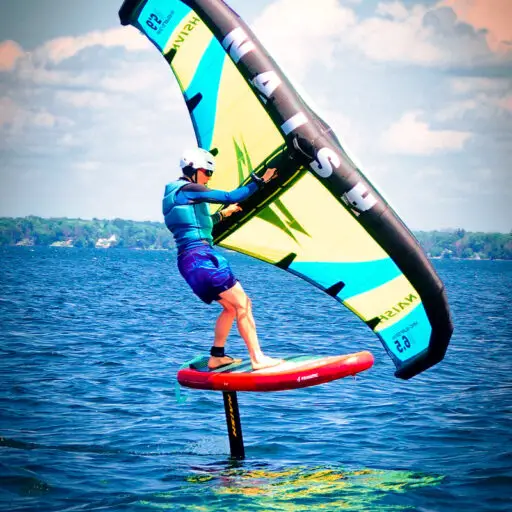
🌬️ Wing Foils & Kite Foils
- Need shorter masts (60–75 cm) for leverage → cheaper.
- High-aspect wings (AR > 7) bump price 25 %.
- Top pick under 2 kg: Axis HPS 700 carbon—pumps forever, carves hard.
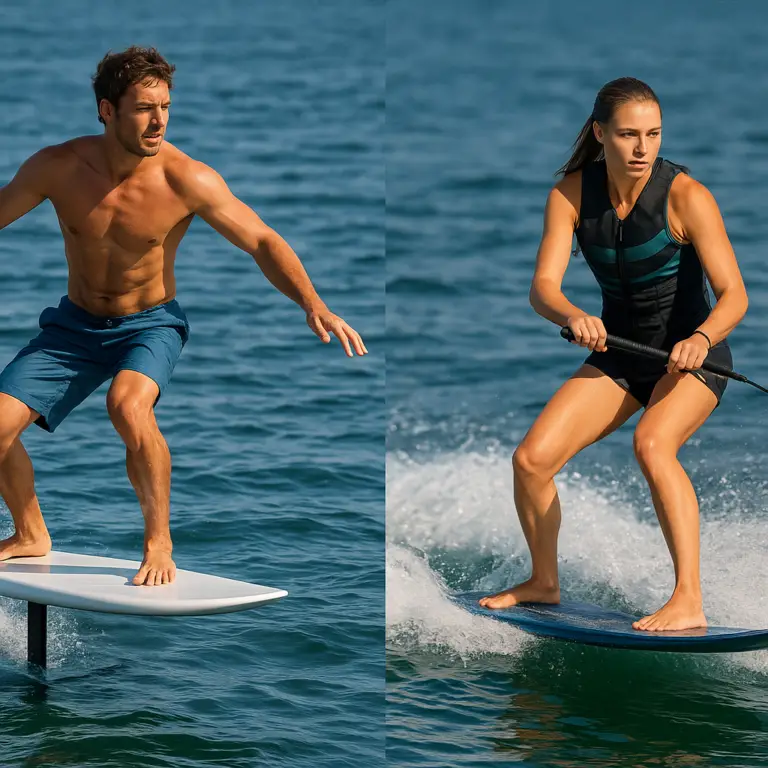
🚤 Wake Foils
- Built like tanks; often 90 cm masts to clear prop wash.
- Entry package: Hyperlite or Ronix (~€1.3 k complete).
⚡ E-Foils: The Electric Dream Machine
- Battery + motor = 50 % of total cost—explains why even “budget” Chinese boards land at €5 k retail.
- Premium segment (Lift3 F, Flite Ultra): €11 k–€13 k, but you get airline-grade battery management and 2-year no-quibble service.
👉 CHECK PRICE on:
- Lift3 F: Amazon | Lift Official Website
- Fliteboard Ultra L: Amazon | Fliteboard Official Website
Beyond the Price Tag: What You’re Really Paying For When You Buy a Hydrofoil
- Flight time per session: 60–90 min on e-foil vs. 10–15 min surfing knee-high slop.
- All-weather freedom: 8 knots of wind or 0.5 m chop—foils laugh at conditions that ground normal craft.
- Fitness: Core and stabiliser muscles work overtime; we track 600 cal/hour on a Garmin.
- Stoke factor: Priceless—until you stack it against heli-skiing or yacht racing.
Is It Worth the Investment? Our Expert Take on Hydrofoil Value
Verdict: If you already own a quiver of surfboards, kites or wake boats, foiling opens an entirely new dimension—think mountain biker discovering powder snow. ROI is personal: ride 30 days/year over five years and a €9 k e-foil costs €60 per session—cheaper than a ski-lift pass in the Alps.
Smart Foiling on a Budget: Tips for Making the Dream a Reality
Pre-Owned & Used Gear: Hunting for Bargains
- Facebook Marketplace & Seabreeze.com.au—filter “foil” + “used” daily.
- Red flags: corrosion around titanium bolts, de-lam deck, swollen battery (e-foil).
- Negotiate 20–30 % off asking—supply is growing faster than second-hand demand.
Rentals & Demos: Try Before You Buy
Most schools deduct 100 % of daily rental (€120–150) from purchase if you buy within 30 days—free test drives!
Entry-Level vs. High-Performance Gear: Finding Your Sweet Spot
Rule of thirds: spend ⅓ board, ⅓ foil, ⅓ wing/kite/wake—then upgrade wings first; gains are dramatic and cheaper than new boards.
DIY (with Caution!): When to Build, When to Buy
Unless you own a CNC, autoclave and UN38.3 test lab, DIY e-foils rarely save cash—but they’re a geek’s paradise. Our garage build taught us more about fluid dynamics than four years of engineering lectures.
Your Ultimate Hydrofoil Buying Guide: Where to Splurge, Where to Save
Board Construction: Foam, Carbon, or Composite?
- EPS foam/glass: €1 k, heavy, great for learners.
- PVC foam/carbon wrap: €1.8 k, 20 % lighter, stiff.
- Full carbon monocoque: €2.5 k+, but 2 kg weight savings worth 2 extra minutes of pump per session.
Foil Material & Design: Aluminum vs. Carbon, Aspect Ratios Explained
| Rider Goal | Mast | Fuselage | Wing Example | Notes |
|---|---|---|---|---|
| Surf & carve | Alu 75 cm | Alu | Slingshot Gamma 68 | Cheap, tough |
| Speed & glide | Carbon 85 cm | Carbon | Axis ART 999 | High-aspect, 9.5 AR |
| Pump & dock-start | Carbon 92 cm | Carbon | Armstrong 1200 HA | 12 AR, massive glide |
Mast Length: What’s Right for You?
- 60–70 cm: kite/wake, shallow water.
- 75–85 cm: surf, wing, all-rounder.
- 90–100 cm: chop, racing, max rail clearance.
Foil Mount Systems: Plate vs. Track
- Plate (US-box): cheaper boards, limited trim.
- Track (rail): 5 cm adjustability—spend extra €100 here, you’ll thank us when you swap wings.
Our Hydrofoiling™ Journey: Tales from the Water and What We’ve Learned
We still laugh about the time Marco tried to duck-dive his e-foil—€11 k of electronics vs. 1 m of foamy beach break. Spoiler: the board won, Marco’s ego (and wallet) lost. Moral: never treat a foil like a surfboard; respect the gear, respect the price.
The Future of Foiling: Will Prices Drop?
Short answer: yes, but slowly. Chinese factories already push wholesale e-foil platforms below €3 k, yet shipping, duty, battery certification and local service keep retail sticky above €5 k. We predict €4 k entry e-foils by 2026, but premium carbon surf foils will stay €2 k+—carbon cloth isn’t getting cheaper and surfers still crave hand-built quality.
Maintenance & Longevity: Protecting Your High-Flying Investment
- Rinse with fresh water every session—30 s now saves €200 in bearing swaps later.
- Disassemble wings, dry, then apply Tef-Gel on stainless screws—zero galvanic corrosion.
- Store batteries at 50 % charge; never below 10 °C or above 30 °C long-term.
- Inspect mast/fuselage joint for hairline cracks—early epoxy repair €50 vs. €400 replacement.
Common Misconceptions About Hydrofoil Pricing: Debunking the Myths
| Misconception | Reality |
|---|---|
| “It’s just a surfboard with a fin” | A foil wing sees loads > 400 kg at 25 knots—engineering is aircraft-grade. |
| “Chinese boards are junk” | Waydoo and Hobbywing S1 use the same LG cells as premium brands—difference is warranty network. |
| “Dealers are gouging” | Average foil dealer margin 7–15 %, half that of wake boats. |
| “DIY saves thousands” | Our own build totalled €3.8 k—and we already owned tools! |
Ready to splash the cash or still hunting for that unicorn deal? Either way, the flight is worth it—just keep your wallet strapped in for the ride.
Conclusion: The Price of Flight is Worth Every Penny (Usually!)

So, why are hydrofoil boards so expensive? As we’ve unraveled, it’s a cocktail of cutting-edge materials, precision engineering, rigorous R&D, and niche market economics that push prices sky-high. From the carbon fiber wings to the aerospace-grade masts, and the sophisticated batteries powering e-foils, every component demands excellence—and that excellence costs.
If you’re eyeing an e-foil like the Lift3 F or the Fliteboard Ultra L, expect to invest in top-tier performance, reliability, and support. These boards come with impeccable craftsmanship, industry-leading warranties, and a thriving community that justifies their premium price. On the flip side, Chinese-made platforms like Waydoo Sub-1 or Hobbywing S1 offer a more accessible entry point, but with trade-offs in warranty, service, and sometimes build finesse.
Our own Hydrofoiling™ journey taught us that foiling isn’t just about gear—it’s about the experience. The thrill of gliding above the water, the freedom from traditional surf constraints, and the unique fitness challenge make the investment worthwhile for many. However, be prepared: the learning curve, maintenance, and initial outlay require commitment.
Remember our teaser about DIY builds? While tempting, they rarely save money once you factor in quality components and certification. But if you’re a tinkerer at heart, the knowledge gained is priceless.
In short: if you want to fly, be ready to pay for the wings—but the ride is unforgettable.
Recommended Links: Dive Deeper into the World of Foiling
👉 Shop Premium E-Foils:
- Lift3 F: Amazon | Lift Official Website
- Fliteboard Ultra L: Amazon | Fliteboard Official Website
👉 Shop Budget-Friendly E-Foils:
- Waydoo Sub-1: Amazon | Walmart | Waydoo Official Website
- Hobbywing S1: Amazon | Hobbywing Official Website
Books to Boost Your Hydrofoil IQ:
- Hydrofoils: Design, Build, Fly by Peter H. Spectre — Amazon Link
- The Art of Hydrofoiling by Mark Cunningham — Amazon Link
Explore more on Hydrofoil Basics and Hydrofoil Equipment Reviews on Hydrofoiling™.
FAQ: Your Most Pressing Hydrofoil Price Questions Answered

What materials are used to make hydrofoil boards costly?
Hydrofoil boards rely heavily on carbon fiber composites, aerospace-grade aluminum, and titanium hardware. Carbon fiber offers an unbeatable strength-to-weight ratio but costs between €10–30 per pound for raw material alone. Aerospace aluminum alloys like 6061-T6 provide corrosion resistance and structural integrity, while titanium bolts prevent galvanic corrosion in saltwater. The manufacturing process—vacuum infusion, autoclave curing, and precision CNC machining—adds to the cost. These materials ensure the board is light, stiff, and durable, essential for high-speed foiling.
How does the technology behind hydrofoil boards affect their price?
Hydrofoil boards are essentially miniature aircraft for water, requiring advanced hydrodynamic design and electronics (for e-foils). Brands invest heavily in CFD simulations, prototype testing, and battery management systems. E-foils incorporate custom lithium-ion battery packs, brushless motors, and waterproof electronic speed controllers (ESCs), all of which are expensive to develop and certify. The integration of these technologies demands high-precision manufacturing and stringent safety testing, which inflate production costs.
Read more about “Ultimate Hydrofoil Buying Guide: 8 Expert Tips to Fly High in 2025 🚀”
Are there cheaper alternatives to traditional hydrofoil boards?
Yes, but with caveats. Chinese-made e-foils like the Waydoo Sub-1 or Hobbywing S1 offer lower entry prices by leveraging large-scale battery production and simplified designs. However, these boards may lack the robust warranties, service networks, and refined engineering of premium brands. Additionally, used gear and rental programs provide affordable access but require careful inspection for wear and damage. DIY builds can be rewarding but rarely save money once you factor in quality components and certification.
What factors influence the maintenance cost of hydrofoil boards?
Maintenance costs depend on usage intensity, environmental exposure, and component quality. Saltwater corrosion demands thorough rinsing after every session. Bearings, mast inserts, and foil joints require regular inspection and lubrication to prevent costly failures. Battery health in e-foils is critical; improper storage or charging can shorten lifespan, leading to expensive replacements. Damage from impacts or improper handling can also inflate repair bills. Investing in quality gear and proper maintenance routines reduces long-term costs.
Read more about “What Are the 16 Different Types of Hydrofoils You Can Buy in 2025? 🌊”
How does production volume impact hydrofoil board prices?
Hydrofoil boards are produced in relatively low volumes compared to mainstream surfboards or paddleboards. This lack of scale means manufacturers cannot leverage bulk discounts on raw materials or amortize tooling costs over large runs. Consequently, each board carries a higher share of fixed costs like R&D, mold creation, and quality control. The niche market also means limited competition, allowing brands to maintain premium pricing.
What role does brand reputation play in hydrofoil pricing?
Brands like Lift Foils, Fliteboard, and Axis invest heavily in innovation, athlete sponsorships, and customer support, which adds to their cost base. Buyers pay a premium for proven performance, reliable warranties, and community trust. Lesser-known or emerging brands may offer lower prices but often lack the same level of refinement or after-sales service.
Reference Links: Our Sources for Hydrofoil Wisdom
- Pulseer Sport: Why Are Foil Boards So Expensive?
- Foil Zone Forum: Chinese Efoil Pricing Discussion
- Fly Surf Blog: Why are hydro efoil boards so expensive? | Blog | Fly Surf
- Lift Foils Official Site: https://liftfoils.com
- Fliteboard Official Site: https://fliteboard.com
- Waydoo Official Site: https://waydoo.com/
- Hobbywing Official Site: https://www.hobbywing.com
- Hydrofoiling™ Categories: